
Why Employee Engagement Platforms Should Own the Reward Experience
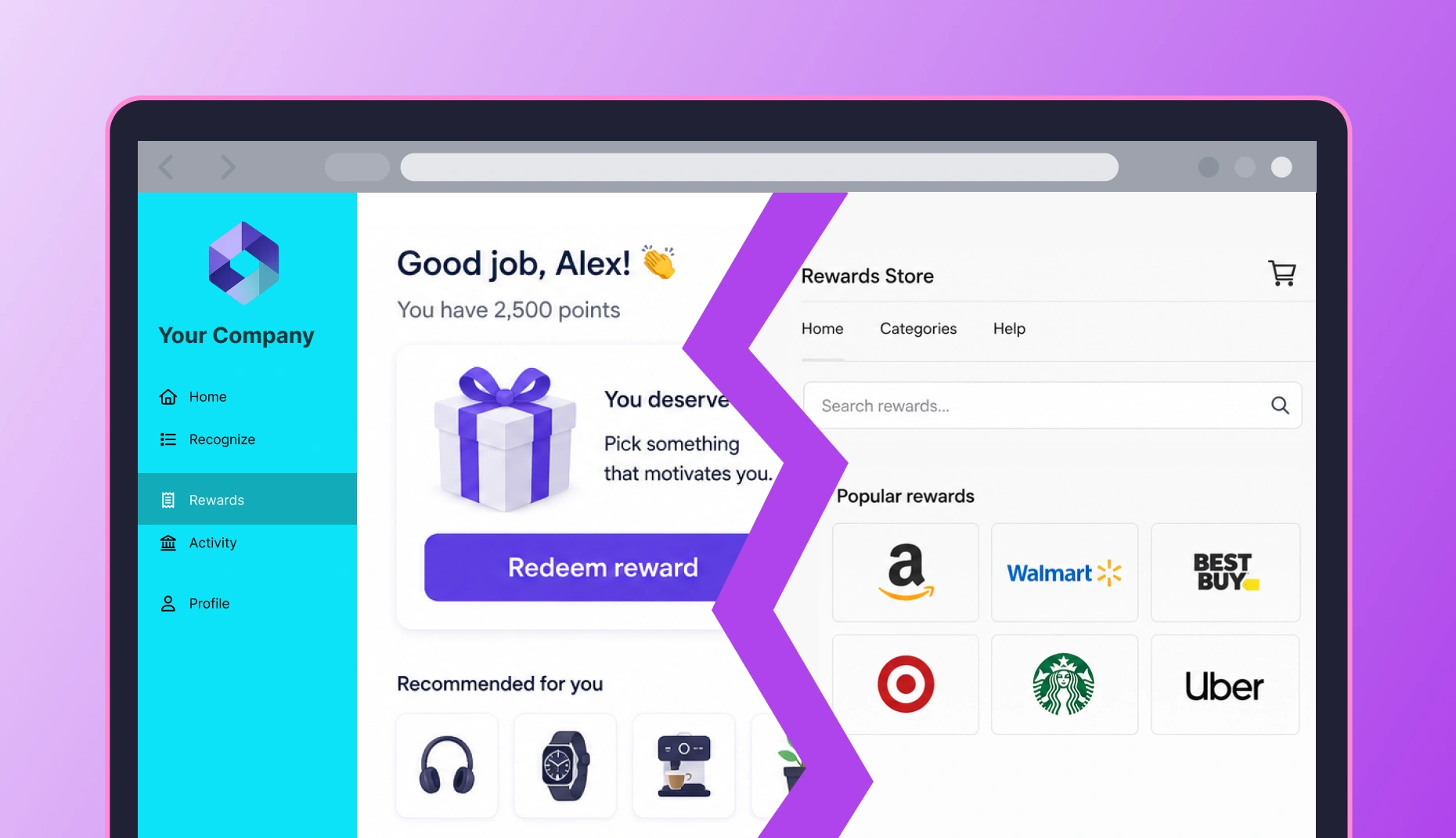
Put yourself in the buyer’s seat for a moment.
You sit through three employee engagement platform demos in the same week. The recognition flows look familiar: peer shout-outs, manager awards, milestone tracking, social feed. Then each demo gets to the redeem step.
Two platforms redirect to a third-party catalog. New tab, different navigation, generic logos. The third keeps the employee inside the product: same design language, branded reward experience, no obvious context switch.
The third platform does not have more features. It just feels finished.
That is the moment the deal tilts. And it is the moment many engagement platforms are still treating as someone else’s product surface.
The latest O.C. Tanner State of Employee Recognition Report found that nearly 40% of employees do not use their recognition tools regularly. That is not just an adoption problem. It is a product experience problem. When recognition feels generic, the message shifts from “we see you” to “we processed this.”
The handoff is the product gap most platforms do not see
The reward moment is the highest-touched, least-owned surface in engagement software. Every employee who participates in the recognition program lands on it, not just admins, managers, or HR teams. And on many platforms, it is the one part of the journey the platform does not fully control.
The shape of the gap is consistent across the category. The employee opens a notification. Reads a thoughtful message from a manager or peer. Clicks claim. A new tab opens. The branding changes. The navigation changes. The catalog becomes a list of logos that could belong to any platform, because it often does. The employee picks something close enough, gets a code from an email template they may not recognize, and closes the tab.
That is not a UX nit. It is the platform disappearing at the moment the employee actually receives value.
In UX terms, the handoff increases the interaction cost: the mental and physical effort a user has to spend to reach their goal. In recognition, that extra effort appears exactly when the employee is supposed to feel the value of being recognized.
It also breaks consistency. Interfaces should make sense to users because patterns, actions, and expectations stay familiar. A reward journey that changes domain, navigation, visual language, and email sender mid-flow creates uncertainty at exactly the wrong moment.
The recognition workflow earns the emotional credit. The reward handoff gives some of it away.
Whatever happens after the click, like what employees choose, how long they wait, whether they come back, becomes harder for the platform to understand if the reward experience lives somewhere else. The product team is left with a partial view of one of the broadest employee touchpoints in the system.
The bar moved while most roadmaps were not looking
Two years ago, the reward question from buyers was mostly a breadth question: how many brands, how many countries, how many reward options. The answer was a list of logos, and the conversation moved on.
That conversation has changed shape.
Feature parity is rising. Peer recognition, manager awards, social feeds, HRIS integrations, analytics dashboards: many of the core features now look familiar across platforms. When the feature set converges, the experience becomes the tiebreaker.
Brand control is also becoming harder to ignore. Buyers want the reward delivery, from card art, claim pages, notification emails, to the entire redemption journey, to feel like part of the employer and platform experience, not a visible handoff to a catalog provider. A generic reward flow may still work functionally, but it weakens the feeling of a complete product.
And employer buyers are evaluating the journey with employees in mind. They notice the redirects. They notice the new tabs on mobile. They notice the brand changes mid-flow. That feedback gets back to the buying committee because the reward experience is no longer hidden in the back office. It is part of the product.
The broader buying environment reinforces that shift. B2B buyers increasingly expect digital experiences to be easier, more self-directed, and more consumer-grade. Gartner has reported that 67% of B2B buyers prefer a rep-free buying experience, a signal that buyers are doing more evaluation through the product experience itself before they ever reach a final sales conversation.
The bar for “complete product” has moved, and the reward moment is where the gap shows up most visibly.
But embedded is not exclusive to one provider
The honest objection a sharp reader will raise is this: native iFrames and embedded reward models already exist in the category. The differentiator is not embedded as a feature toggle. It is whether your reward infrastructure can do three things at once.
First: embedded and unified. The same integration should support the reward types your customers need across the moments they care about, from gift cards to prepaid cards to push-to-card payouts. Most platforms did not choose to fragment their reward stack. It happened one bolt-on at a time, each with its own front end, provider logic, reporting, and operational edge cases. Unifying that into one API is what keeps the embedded experience consistent across reward types, not just gift cards.
Second: embedded and global. Localized choice matters more when your customers serve multinational workforces. For engagement platforms, the real test is not whether rewards work beautifully in one market. It is whether the reward experience can stay consistent across countries, currencies, and recipient preferences without a new vendor workstream for every geography. It’s about bringing together gift cards, prepaid cards, and other payout options in one place so platforms can expand reward choice without rebuilding the experience market by market.
Third: embedded and production-grade. Recognition comes in waves. Year-end cycles, company milestones, holiday batches, sales incentives, manager-driven campaigns: the moments that matter often arrive in spikes. An embedded experience only works if the infrastructure behind it can hold up when thousands of rewards go out at once.
A short audit you can run this week
Walk your own product like a buyer and answer five questions.
1. Does the employee leave your product to redeem?
A new tab, new domain, or visibly different interface, even through an iFrame, is a handoff.
2. Would a buyer notice the seam in your demo?
If your sales team skips the redeem step, that is a signal.
3. Can employer customers brand the reward delivery?
Look beyond the admin dashboard. Can they control the card art, claim page, notification email, and recipient journey?
4. Do you have behavioral data past “reward issued”?
If analytics stop there, you are blind on one of the broadest touchpoints in the employee experience.
5. Could a competitor match your reward experience by signing the same vendor contract?
If yes, the reward layer may be functional, but it is not meaningfully differentiated.
Two or more gaps, and the reward experience is probably working against your stickiness, not for it.
That matters because recognition quality has measurable business stakes. Gallup and Workhuman research found that well-recognized employees are 45% less likely to have turned over two years later. If the reward is where recognition becomes tangible, then the reward experience is not a fulfillment detail. It is part of the retention engine.
The harder work is not finding the infrastructure. It is deciding that the reward moment belongs on the product roadmap, not the procurement one.
Gift cards, prepaid cards, and push-to-card payouts are not just fulfillment options. They are product surfaces. The question is whether your platform owns them, or whether someone else gets the final touch.
Talk to one of our payout experts to see how Runa helps employee engagement platforms build embedded, branded reward experiences through one integration.