
The Real Reason Platforms Switch Reward Providers: Trust Broke First
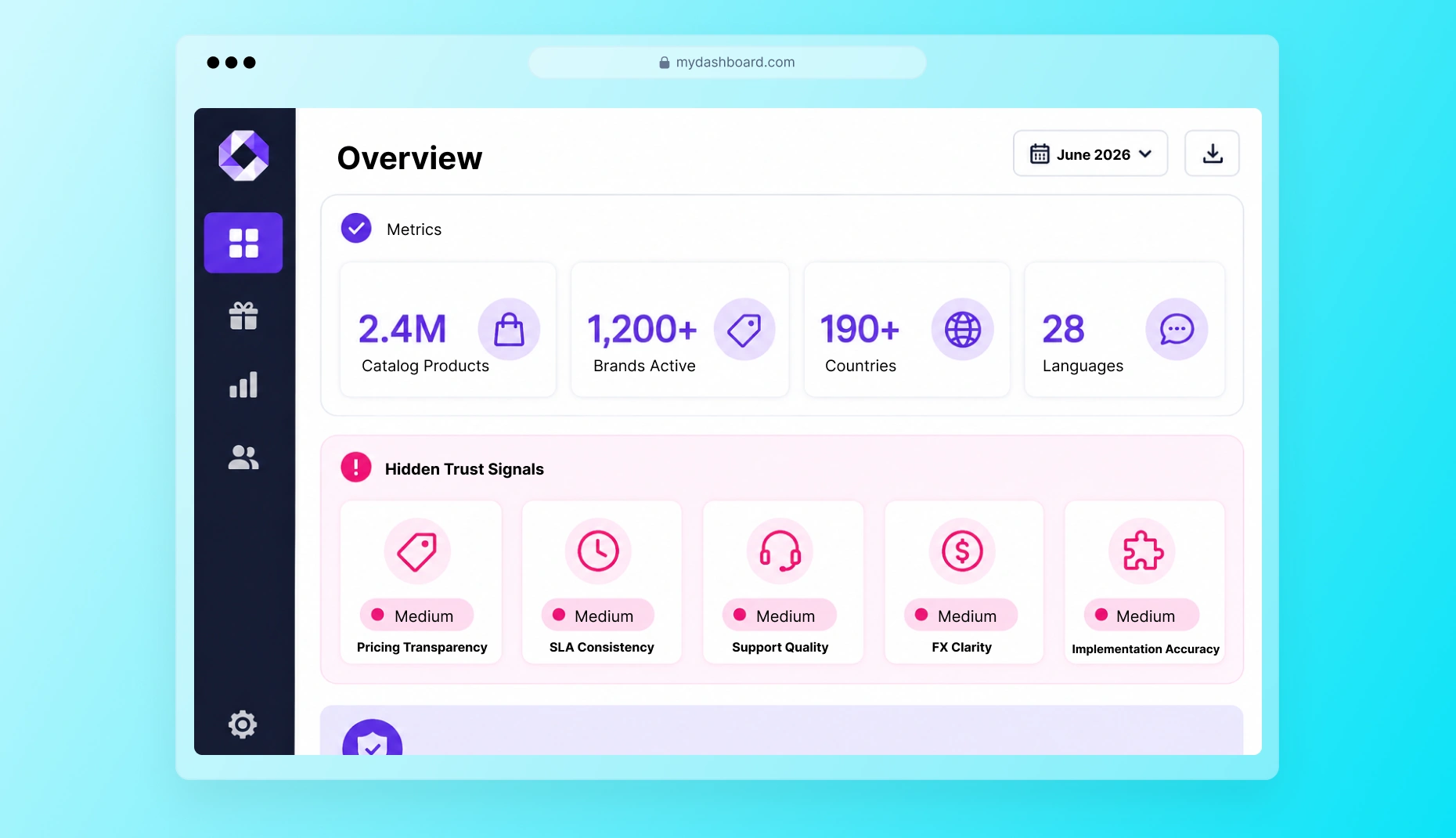
If you run partnerships at an employee engagement platform, you know the Monday meeting.
Finance asks why reward costs came in over plan. Product asks why a brand the team has been promising employer customers for two quarters still isn’t reliably in the catalog. Someone flags another support ticket sitting unanswered into day four.
You’re the one explaining. Every line item, every missing brand, every degraded SLA points back to the provider you chose.
This is what actually drives most reward provider switches. Not a flashier competitor demo. Not a feature gap. A slow, compounding loss of trust in the partner you’ve already integrated and staked your internal credibility on.
And it isn’t a niche pattern: a 2025 Gartner survey of 632 B2B buyers found that 69% report inconsistencies between what a vendor says on its website and what its sellers say in conversation, which “can create mistrust, potentially putting the transaction at risk”. Reward providers are not exempt. Most vendor content avoids naming this dynamic. This post doesn’t.
The category has a trust problem, and almost no one says it out loud
Talk to enough employee engagement platforms about why they’re evaluating new reward providers, and the same words come up. Moved the goalposts. Said one thing, did another. Couldn’t supply the brands they promised. Couldn’t give us a straight answer on FX.
These aren’t isolated complaints. They’re a category-wide pattern that emerges when reward providers prioritize new-logo acquisition over partnership quality: strong engagement during evaluation, quiet degradation in everything that comes after. By the time a Partnerships lead opens a formal evaluation, the real decision was made months earlier. The RFP is the process catching up.
How trust erodes, by persona
Trust erosion doesn’t hit every seat on the buying committee the same way.
Partnerships feels it first, and most personally. You picked this provider. When pricing shifts without warning or a promised brand goes intermittent, you’re the one fielding the questions. The provider’s reliability and your credibility are the same thing.
Product feels it through the experience employer customers see. A spot award that arrives late. A milestone gift card that returns an error. A peer recognition flow that breaks at the worst moment. Trust erosion turns slow launches and rigid infrastructure into roadmap drag.
Finance feels it through the model. Opaque FX. Pricing that drifts after year one. Cost structures that can’t be cleanly audited. For Finance, unclear economics are not just annoying — they are a renewal risk, a forecasting risk, and a trust signal. That matters because pricing transparency was the number 1 change B2B tech buyers wanted from vendors, cited by 45% worldwide.
When all three personas are frustrated at once, the switch decision is already made.
The counter-argument worth naming
The honest objection is that switching reward providers is expensive. Re-integration. Re-training. Catalog migration. Awkward conversations with employer customers about why something is changing. Some platforms read all this, recognize their situation, and still decide the switching cost is higher than the ongoing friction.
Sometimes that math is right. If your provider’s pricing is consistent, catalog reliable, and support hasn’t degraded, staying is the correct call. Not every platform should switch, and any vendor implying otherwise is selling something.
But the calculus is wrong more often than it looks, because the ongoing cost of an eroding partnership rarely shows up as a single budget line. It shows up as margin leakage from FX you can’t audit, engineering hours spent on workarounds, Finance reconciliation work that grows quarter on quarter, and employee experiences that quietly degrade in the moments that matter most to your employer customers. Add those up over twelve months and the switching cost looks less imposing.
From feature checklist to trust checklist
If trust is what breaks reward partnerships, trust-relevant criteria should lead the evaluation for the next one. A practical checklist for any reward infrastructure partner:
- Economic clarity. Is the pricing model fully transparent, including FX and any cost dynamics that change over time? Can Finance audit it end to end?
- Delivery reliability at high-stakes moments. Can the provider deliver consistently on spot awards, milestone celebrations, wellness incentives at the moments where a failure is most visible to your employer customer?
- Integration honesty. Does the pre-sales integration estimate match post-sales reality? Reference-check this specifically. Ask customers where implementation matched the promise, where it drifted, and how the provider behaved when things got messy.
- Support consistency. Is the support experience in month twelve the same as in month one?
- Communication defaults. Does the provider proactively share limitations and changes, or does the platform learn about them through failure?
- Global infrastructure depth. Is multi-currency, multi-country payout native to the platform, or stitched together behind the scenes with regional workarounds?
- Flexible payout options. If the provider only solves for gift cards, ask what happens when an employer customer wants more flexible reward options, like prepaid cards or other spend-anywhere formats.
A provider that aces the feature comparison but fails these behavioral dimensions will recreate the same trust dynamic with a different logo.
Evaluate for the partnership, not just the product
The most important criteria for your next reward infrastructure partner aren’t on the feature matrix. They’re in the behaviors you can observe before you sign and reference-check from platforms a year in. How transparent are the economics? How consistent is the delivery? What does support look like long after the sales cycle ended?
If the Monday meeting in the opening of this post sounded familiar, you already know what you’re solving for. The opportunity now is to evaluate the next provider on what actually sustains.